


Same-Sex Attraction and Gender Identity: An Islamic Perspective
✒ Raihan Shaheed
2 October 2026, 0 21 Rabi al-Thani 1448 AH
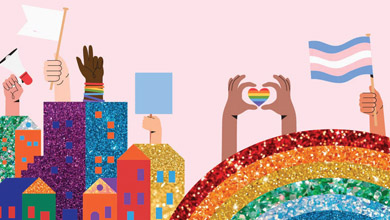
One of the most controversial and widely discussed social issues of the twenty-first century is the LGBTQIA+ movement. A few decades ago, this issue was largely confined to limited social and political discussions in Western countries. Today, it has developed into an ideological movement with significant global influence. The discussion touches various areas of social life, including human rights, individual freedom, gender identity, the concept of family, religious beliefs, legal systems, education and public policy.
Every year in June, the LGBTQ+ community around the world observes Pride Month, claiming to protect their identity and rights. During this period, discussions about the rights, history, experiences and social recognition of the LGBTQIA+ community become more prominent. Parades and public events are organised in many countries. At the same time, criticism and discussions from religious and moral perspectives also become active.
In this context, it is essential to examine the subject historically, religiously, scientifically and socially rather than reducing it to emotional reactions or slogans. This is because LGBTQIA+ does not refer merely to sexual attraction. It encompasses numerous questions concerning fundamental concepts such as human identity, gender, family, marriage, social structure and morality.
Discussions related to LGBTQIA+ are no longer limited to personal sexual behaviour. They have become part of a much broader cultural debate encompassing everything from school education to legislation, from the definition of marriage to the definition of gender, and from human rights to religious freedom. Therefore, a clear understanding of this subject is necessary for every reader.
What Does LGBTQIA+ Mean?
Many people do not clearly know what each letter in LGBTQIA+ represents. Therefore, it is first necessary to understand the concept.
LGBTQIA+ is an “umbrella term” that includes various sexual orientations and gender identities.
L = Lesbian
“Lesbian” refers to a woman who experiences sexual or romantic attraction towards women. If a woman primarily experiences romantic or sexual attraction towards another woman, she is referred to as a lesbian.
G = Gay
The term “gay” is generally used to refer to people who experience same-sex attraction, although it is commonly used specifically for men who experience sexual or romantic attraction towards men.
B = Bisexual
“Bisexual” refers to a person who experiences sexual or romantic attraction towards both men and women. Their attraction need not be limited to one gender alone.
T = Transgender
“Transgender” refers to a person who considers their gender identity to be inconsistent with the sex assigned to them at birth. The subject here is gender identity, not sexual orientation.
Q = Queer / Questioning
The letter Q is generally used in two senses.
Queer: A broad term used to refer to people who fall outside traditional categories of sexuality and gender.
Questioning: It can also refer to people who are still exploring or questioning their sexual orientation or gender identity.
I = Intersex
“Intersex” refers to a biological condition in which, due to genetic, hormonal or physical factors, a person cannot be easily classified into clearly defined male or female categories. It is a medical condition.
A = Asexual
“Asexual” refers to a person who experiences little or no sexual attraction towards others.
+ Plus
The “+” symbol in LGBTQIA+ is significant. It includes other sexual orientations and gender identities beyond those mentioned above.
The History of Homosexuality
Although the term LGBTQIA+ is modern, homosexual behaviour is not new in human history. It has been recorded in various forms across different societies and cultures throughout history.
Although there are historical references and records of same-sex relationships in ancient Mesopotamia, Egypt, Greece and Rome, there is no clear evidence that these societies generally adopted homosexuality as an accepted form of marriage.
The People of Prophet Lut (AS)
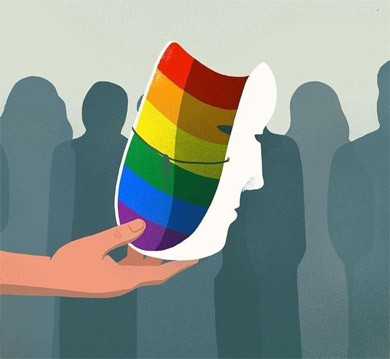
One of the oldest and most famous historical accounts concerning homosexuality is that of the people of Prophet Lut (AS). This incident is discussed in detail in Jewish, Christian and Islamic scriptures.
Religious scriptures record that the men among the people of Prophet Lut (AS) abandoned women and expressed sexual attraction towards men. The scriptures also state that they were subjected to divine punishment because of this.
The Medieval World
During the medieval period, most cultures around the world regarded homosexuality as morally wrong. In Europe, Christian churches considered it a sin. A similar position existed within Jewish communities. In the Muslim world, homosexual sexual acts were also prohibited. In many Asian societies, including India, such acts occurred in some places, but they were not regarded as a social ideal.
The Beginning of the Modern Era
During the eighteenth and nineteenth centuries, the influence of religion declined in Europe while greater importance was given to individual freedom. This led to new discussions about sexuality. The term “homosexuality” was first used in 1869. Before that, other terms were used to describe such behaviour.
Towards the end of the nineteenth century, some psychologists and social thinkers began studying homosexuality as a psychological subject rather than merely as a crime or sin.
The Turning Point in the Twentieth Century
The “Stonewall Riots,” which took place in New York in the United States in 1969, are widely regarded as a significant beginning of the modern LGBTQIA+ movement. Following this event, homosexual rights movements became more organised. Protests demanding legal changes began in various countries.
In 1973, the American Psychiatric Association removed homosexuality from its classification of mental disorders. The World Health Organization later adopted a similar position. The claim made here is that it was removed without scientific support and merely due to pressure.
By the end of the twentieth century and the beginning of the twenty-first century, the LGBTQIA+ movement had become a global political force. Historically, homosexuality was primarily viewed as a behaviour. The modern LGBTQIA+ movement, however, presents it as an identity. This represents one of the most significant historical changes.
Perspectives of Different Religions
The major religions of the world have established clear moral positions regarding marriage, family and sexuality. Explicit references criticising same-sex sexual relationships can be found in Jewish and Christian scriptures. The Book of Leviticus in the Torah prohibits same-sex sexual relations (Leviticus 18:22; 20:13). Similarly, in the New Testament, Paul is presented as criticising homosexual sexual activity (Romans 1:26-27; 1 Corinthians 6:9-10). Therefore, historically, Jewish, Catholic, Orthodox and traditional Protestant traditions regarded homosexuality as sinful or prohibited. In modern times, however, some liberal Jewish and Christian groups have attempted to reinterpret these positions.
Since Hinduism is not a scripture-based religion centred on a single authoritative text, it is difficult to identify one unified official position on this issue. References to gender diversity can be found in some Puranas and epics, but many Hindu scholars maintain that these cannot be directly equated with the modern LGBTQIA+ ideology. Generally, Hindu Dharmashastra traditions present marriage as a relationship between a man and a woman.
The Islamic Perspective
Islam does not deny human sexual desire. Rather, it recognises it as a natural human inclination. However, it establishes moral and legal boundaries for such desires. Just as hunger does not justify stealing, the existence of a desire does not mean that acting upon that desire is permissible. This is the Islamic approach.
As mentioned earlier, the people of Prophet Lut (AS) engaged in homosexual acts. The Qur’an describes this people, their sexual wrongdoing and the punishment they received in several surahs.
Allah says:
“And [We sent] Lut when he said to his people, ‘Do you commit such immorality as no one has preceded you with from among the worlds? Indeed, you approach men with desire, instead of women. Rather, you are a transgressing people.’” (Qur’an 7:80-81)
“Do you approach males among the worlds and leave what your Lord has created for you as mates? Rather, you are a people transgressing.” (Qur’an 26:165-166)

These verses make it clear that the natural and permissible form of sexual relations is through marriage between a man and a woman, and that Allah has prohibited a man from sexually approaching another man instead.
Some people today argue that Allah condemned the people of Prophet Lut (AS) because they intended to rape and humiliate their guests, rather than because of homosexuality itself.
However, the verses quoted above refute this argument.
Islam does not regard feelings and attractions that arise involuntarily in a person's mind as sinful in themselves. A person may experience same-sex attraction. It may be a test. However, acting upon that attraction is sinful. The Prophet ﷺ said:
“Allah has forgiven my Ummah for what occurs in their minds so long as they do not speak about it or act upon it.” (Bukhari and Muslim)
The Scientific Perspective
One of the most frequently raised arguments in contemporary discussions about LGBTQIA+ is that “it is innate,” “the gay gene has been discovered,” and “science has proven it.” What does the scientific community actually say about this subject? To answer this question, the issue needs to be examined in light of research rather than emotion.
The first thing to understand is that there is still no complete scientific consensus regarding human sexual orientation. No clear and final scientific answer has yet been established regarding why same-sex attraction occurs.
Has a “Gay Gene” Been Discovered?
During the 1990s, some studies suggested that same-sex attraction might be associated with certain genetic factors. Based on this, the media widely circulated headlines claiming that a “gay gene” had been discovered. However, subsequent large-scale studies did not confirm this claim.
One of the largest genetic studies published in 2019 examined the genetic information of hundreds of thousands of people. Its conclusion was significant: there is no single gene that determines same-sex attraction. Therefore, the “gay gene” has not been scientifically established.
Does Science Determine Morality?
Another important point must be understood here. Even if something is shown to be biologically influenced, that does not by itself prove that it is morally right. For example, human beings naturally experience anger, jealousy and aggressive impulses. Yet this does not mean that all of these are morally acceptable.
Therefore, “a tendency has biological factors” and “that tendency is morally right” are two different claims. Science can comment on the first. The second belongs to the fields of morality, philosophy and religion. Science cannot determine it.
Transgender and Intersex
Among the most misunderstood subjects in contemporary discussions about LGBTQIA+ are transgender and intersex identities. In public discussions, the media and social media, these two categories are often presented as though they are the same. However, medically, socially and Islamically, they are different concepts. Understanding this distinction is essential for understanding the Islamic position.
Intersex refers to a condition in which a person's biological sex characteristics at birth cannot be clearly classified as typically male or female. Some circumstances that may fall under this include:
* Unusual genital anatomy.
* Chromosomal variations.
* Hormonal imbalances.
* Conditions in which certain physical characteristics of both males and females are present.
Intersex is not an “identity.” It is a biological and medical condition. It is not the result of a person's choice. A person is born intersex. In Islamic jurisprudence, intersex individuals are referred to as “khuntha.” Muslim scholars discussed this issue centuries before the development of modern medicine. Classical jurisprudential works discuss in detail where an intersex person should stand during congregational prayer, what share they should receive in inheritance and what rules apply to their marriage. This demonstrates that Islam recognised the existence of intersex individuals and gave their condition specific legal consideration.
“Transgender” refers to a person who considers there to be a mismatch between their biological sex at birth and their self-identified gender identity. For example, a person born male may believe themselves to be female, or a person born female may believe themselves to be male.
Here, the person's biological structure may be ordinarily male or female, while the individual understands their identity differently. Therefore, transgender primarily concerns gender identity, whereas intersex is a biological condition.
The Islamic Position on Gender-Reassignment Surgery
1. Intersex individuals
When a person's biological sex cannot be clearly determined, a number of contemporary scholars have held that medical procedures intended to clarify the person's sex on the basis of medical examinations are permissible. This is because such treatment does not create a new sex; rather, it clarifies the person's actual biological condition.
2. A person who is ordinarily male or female
Scholars have generally held that it is not permissible for a person to undergo surgery in order to change their biological sex.
Conclusion
In summary, this subject is not merely a discussion about LGBTQIA+. It is a discussion connected to fundamental questions such as who human beings are, what their nature is, who created them and who determines the standards by which they should live. As the idea “I am whatever I feel I am” becomes stronger in society, the boundaries surrounding gender and human identity are gradually becoming blurred. A society that once discussed two basic biological realities, male and female, has now reached a stage where it is being asked to recognise an ever-expanding range of gender identities and personal identifications.
In some Western societies, there are even tendencies for people to distance themselves from their biological reality and identify themselves as animals or fictional identities. Many view this as a warning of what can happen when human desires and emotions are made the ultimate authority: eventually, the boundaries between truth and falsehood, nature and distortion, reality and imagination themselves may disappear.
For a Muslim, however, the standard of truth is not the changing opinions of people, but the unchanging guidance of Allah. Even if people normalise, legalise and celebrate something, a believer cannot regard what Allah has made haram as halal. This is because the goal of a Muslim is not the approval of people, but the pleasure of Allah.
As the Qur’an teaches, the fact that the majority of people on earth follow a particular path does not prove that the path is true. Therefore, in an age filled with temptations, pressures and confusion, the responsibility of a believer is to preserve their pure natural disposition, uphold the boundaries established by Allah, and speak the truth with compassion and wisdom. Allah’s guidance leads human beings towards true dignity and success, while every step away from it takes a person further from their true purpose. At such a time, standing firm upon the truth is not merely an intellectual position; it is also a great act of worship and a sign of faith.
Translated By: Zainab Binth Farhan