


Racism in the Newsroom: A Textbook Case!
✒ Dr. Abdullah Basil CP
2 October 2026, 0 21 Rabi al-Thani 1448 AH
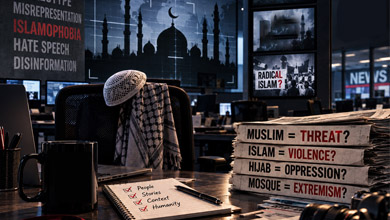
Concerns are growing over whether the media, which plays a decisive role in shaping public consciousness in Kerala, is becoming a hub for communal and racial polarization instead of fostering healthy dialogue. Under the guise of criticism, deliberately vilifying the religious terminology of a community by linking it with obscenity and criminality is racial hatred. Furthermore, the generalization that portrays an individual’s conservative stance as the burden of the entire community is dangerous.
Media debates and newsrooms play a major role in shaping public consciousness in Kerala. However, in recent times, a serious question is being raised before society as to whether these newsrooms are transforming into centers for producing communal and racism-driven polarization instead of healthy dialogue.
A debate broadcast on a Malayalam news channel regarding a remark made by Kanthapuram A.P. Aboobacker Musliyar, along with the developments that followed, makes this question even more relevant. When such discussions shift beyond mere disagreement with an individual's conservative views and cross into language that puts an entire community in the dock, it ceases to be just an issue with a single media outlet. Rather, it stands as an indicator of dangerous trends unfolding within Kerala's democratic spaces.
The Distance Between Criticism and Racial Slurs
In a democracy, no one is beyond criticism. Any media outlet has every right to sharply criticize a religious scholar’s statements and dismantle their lack of logic; that is the very foundation of debate. However, the language used and the wording on the news cards in the debate in question crossed those boundaries of constructive criticism:
•"There are religious scholars who believe that even if a guy smokes weed, gets arrested in an MDMA case, or molests someone else's woman, it is considered a Sunnah from the Kitab."
•"Are all educated women bastards?"
•"Is all the Sunnah of the Kitab meant only for men?"
•"Why is 'don't forget to cover the Aurat' told only to women?”
A close examination of these expressions reveals one thing clearly: this is not mere disagreement with an individual. Instead, technical terms specific to a particular religious community such as Sunnah, Haram, Kitab, and Aurat are being intentionally used in a derogatory manner. Generalizing an individual’s fault by tying it to the entire belief system of a community is a glaring manifestation of racism. Such actions inflict pain upon believers and generate false narratives within society.
From the Invitation to the Debate
The author received the invitation to the debate behind the incident on 31/08/2026. The invitation was accepted and we mentioned that there are different religious perspectives regarding women's public presence than the one put forward by Kanthapuram. Initially, three others were named as panelists. However, just an hour before the discussion, posters appeared on social media showing that a hate-mongering YouTuber would also be participating in the debate.
I immediately contacted the anchor and informed her that I accepted the invitation under the misconception that it was a decent debate, and that it was wrong to organize the discussion without informing me about the inclusion of someone of such low standard. Moreover, this hate-mongering YouTuber is someone who had sexually insulted my mother and posted vile language on Facebook, regarding which legal action is currently underway. I stated that I had no interest in participating in a debate with such a person and that I was withdrawing. Although the anchor tried hard to include the hate peddler in the debate, he ultimately had to be excluded. However, what was seen next was everything that the hate peddler intended to say coming out through the anchor's own tongue!
Although I pointed out during the debate itself that it was wrong and demanded an apology, the anchor was not willing to do so, nor did she give me sufficient time to speak. That is why, immediately after the debate, I released a video on social media pointing out what had happened and playing the anchor’s racist remarks. Consequently, people across caste and religious lines came forward against the channel, demanding an apology.
Ultimately, the channel was forced to withdraw the debate containing the racist remarks. However, instead of openly admitting in their statement of regret that racism had occurred, the channel relied on phrases such as "in the context of some people misinterpreting and circulating..." and "if anyone's sentiments were hurt...". Approaching such severe racist remarks with a complete lack of sincerity and seriousness led to further criticism. Yet, what followed was even more bizarre…
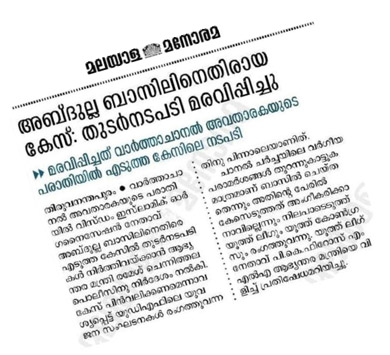
The anchor who uttered the hateful words filed a police complaint against the author who pointed them out! While the police took no action against the anchor who spewed racial hatred on air, they hastily registered a case against the author, including non-bailable charges. Celebrating this, the anchor and the channel even put out news cards declaring, "Accused No. 1, Abdulla Basil"!
The most frightening aspect of this issue is that the police hastily registered an FIR against the individual who questioned racial bias with evidence. The logic behind naming someone as an accused here requires close scrutiny. A person creates an analytical video on a public issue, and thousands of people comment on it. If some unknown user posts an illegal comment under that video, how does the creator of the video become Accused No. 1?
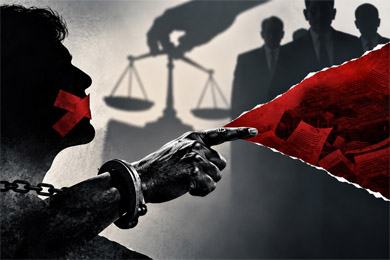
This case is not merely an action against a single individual; it sets a dangerous "precedent" that could be weaponized against anyone in the future. If this logic is accepted, no activist or journalist in Kerala will be able to express their views freely. It creates a situation where anyone can be framed in a criminal case using a fake account and a malicious comment.
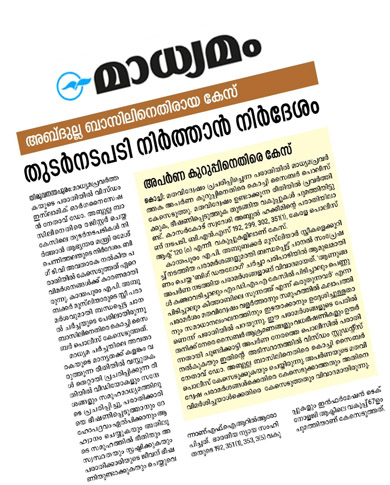
Although the police agreed to put the case on hold following strong public protest, that is not a complete solution. Freezing a case is a threat that can be reactivated at any time. Having an FIR hanging over someone's head is aimed at 'freezing' their public life and freedom of expression. Rather than whether one will be convicted, the success of such cases is measured by whether it makes the person hesitate to speak out in the future.
Double Standards in Law Enforcement and Government Intervention
It is notable that strong political intervention took place against this double standard this time. Leaders from the Youth League and Youth Congress, public representatives, and leaders of various organizations stood up for justice. Furthermore, the courage shown by leaders within the ruling party coalition to acknowledge the mistake rather than justifying their police force's actions was significant. Although Left leaders did not come forward to speak out for justice, Left-leaning activists on social media stood firmly on the side of justice. As a result, the Home Minister intervened, freezing the case against the author, initiating an investigation against the YouTuber spreading hate, and ultimately booking him under non-bailable charges. While this action is welcome, the practice where action occurs only on complaints that gain significant public attention needs to change. It must become part of the system's natural, standard procedure.
The Normalization of Hate
Vocabulary that was non-existent in the public discourse of Keralites a decade ago now flows unchecked into newsrooms. There is a clear history behind this. This is the creation of a group of hate-mongering YouTubers and pro-Zionist profiles who injected obscene and racist terminology into public discourse under the guise of religious criticism.
The language they crafted began in YouTube comment sections, gradually entered everyday conversation, and has now grown into mainstream news studios. The greatest tragedy is that when this vocabulary passes through the hands of the news scriptwriter, the anchor reading it, and the designer creating graphics for it, none of them feel any sense of abnormality. Islamophobia has taken root that deeply in their subconscious minds.
More than deliberate hatred, what is truly to be feared is hate that has been "normalized" in this manner. This is because when something becomes commonplace, pointing it out only invites the counter-question, "What's wrong with this?" Therefore, subjecting that news anchor as an individual to cyberattacks serves no purpose. Rather than hunting down an individual, what is necessary is to challenge this social atmosphere and the system that built it.
Lessons Media Needs to Learn
Fundamental corrections are essential in the debates media conduct centered around controversies:
•Understand Society and Culture: Before criticizing a community or religion, media personnel must have at least a basic understanding of their vocabulary, beliefs, and internal diversity. Continuously repeating stereotypes without understanding their meaning is not criticism, it is an insult.
•The Trap of Generalization: Media must stop framing statements made by an individual or organization in a community as the collective burden of that entire community. Expecting an entire community to answer for one person's fault is not journalism.
•Keep Hate Speech Out: Editorial vigilance must be exercised to keep language and frames crafted by hate peddlers in cyberspace out of newsrooms.
•Sincerity in Apologies: If a racist remark occurs, going beyond issuing a superficial public apology just to wriggle out of it, society requires sincere corrections that clearly specify which remark was problematic and offer an assurance that it will not be repeated.
Exposing racial bias before society is not a crime; rather, it is essential for maintaining a healthy democratic society. It gives immense hope that there is still a large section of people in Kerala willing to speak up against injustice regardless of caste, religion, or politics.
When mistakes are pointed out, what people expect from mainstream media is a willingness to accept and correct them. Instead of shutting the doors on discussions and debates to intimidate through legal action, Kerala must evolve into a platform for clearer discourse where ideas are countered with ideas. Healthy intellectual debate must replace legal cases.
Translated By: Beena Subair