


The Prophet’s ﷺ Hajj Journey: History and Lessons
✒ E. Yusuf Sahib Nadwi Oachira
7 October 2026, 26 Rabi' al-Thani 1448 AH
Complete submission to Allah is the essence of every act of worship in Islam. Like Salah, fasting, and Zakah, Hajj is one of the most important of the five pillars of Islam.
Hajj is a sacred journey in which physical and financial sacrifices come together, and it is made obligatory only once in a person’s lifetime. The humility and supplication displayed by pilgrims of all ages, both men and women, at Arafah, Muzdalifah, and Mina truly embody the purpose of creation: worship.
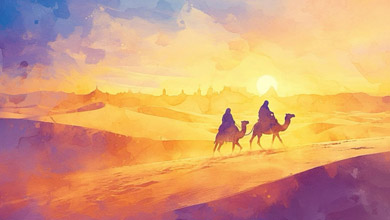
In the tenth year after Hijrah, during the month of Dhul-Qa‘dah, the Prophet ﷺ decided to set out for Hajj. Upon hearing the news, his followers came pouring in from the surrounding areas of Madinah. On Saturday, the 25th of Dhul-Qa‘dah, after the Dhuhr prayer, the Prophet ﷺ departed from Madinah. Thousands of believers lined up before him, behind him, and on either side of him, stretching as far as the eye could see. Reciting the Talbiyah, “Labbayk,” the Prophet ﷺ proceeded on his journey. Passing through Arj, Abwa, Usfan, and Sarif, he reached Makkah on the 4th of Dhul-Hijjah. Upon entering the Haram, the Prophet ﷺ kissed the Hajar al-Aswad and circumambulated the Ka‘bah seven times. He then prayed behind Maqam Ibrahim and performed Sa‘i between the hills of Safa and Marwah. Standing atop Safa facing the Qiblah, he praised Allah and proclaimed His Oneness.
On Thursday, the 8th of Dhul-Hijjah, the Prophet ﷺ proceeded to Mina. After completing the five daily prayers there, he set out for Arafah. He rested in a tent prepared for him at Namirah, near Arafah. When the sun had passed its zenith, the Prophet ﷺ mounted his camel, Qaswa, and reached the plain of Arafah, where he delivered his historic Farewell Sermon.
He declared that human blood, wealth, and honour are sacred, and completely rejected the superstitions and practices of the Age of Ignorance as well as usury. He reminded the people of the rights of women and the compassion that should be shown towards them. Three times, he asked whether he had conveyed his message to the people. When they testified that he had, he called upon Allah to bear witness to it. It was there that the Qur’anic verse declaring the completion of the religion was revealed.
The Prophet ﷺ then proceeded to Muzdalifah, where he combined Maghrib and Isha prayers and rested until Fajr. Before sunrise, after supplicating at Al-Mash‘ar al-Haram, he proceeded towards Mina.
At Mina, he stoned Jamrat al-Aqabah and then personally slaughtered 63 camels, indicating his age of 63, entrusting Ali (RA) with the slaughter of the remaining animals. After shaving his hair and changing his clothes, he went to Makkah and performed Tawaf al-Ifadah. He drank Zamzam water and praised those who were distributing it to the pilgrims.
After staying in Mina during the days of Tashreeq and completing the stoning rituals, the Prophet ﷺ finally performed Tawaf al-Wada‘, the Farewell Tawaf, before returning to Madinah.
Islamic history has recorded the Hajj of the Prophet ﷺ with such remarkable precision that it is as though we can directly witness every movement and hear every word he made and spoke. The Prophet ﷺ taught that even those who are unable to complete these rituals fully because of crowds or other difficulties will receive the complete reward from Allah due to the sincerity of their intentions.
Allah also promises those who face limitations during Hajj the same reward received by those who longed to accompany the Prophet ﷺ but were compelled to remain behind in Madinah because of physical incapacity. To precisely follow the method of Hajj taught and practised by the Prophet ﷺ is one of the greatest blessings in a believer’s life.
Translated By: Raihan Shaheed