


Women in Mosques: The ‘Haram’ Fatwa of the Clerics
✒ Moosa Swalahi Kara
12 September 2026, 01 Rabi'ul Akhir 1448
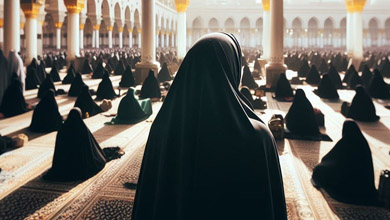
That believing women are allowed to go to mosques to participate in Friday Jumuah and congregational prayers. This is a permission granted by Islamic religious texts, dating back to the time of the Prophet ﷺ. The scholars of Ahl-us-Sunnah have documented this fact in their works.
However, the clerics of Samastha ruled that the authentic legal ruling on this matter is "Haram". Furthermore, they mocked those who state that it is permissible, claiming it to be a novelty/innovation. When faced with undeniable proofs, they faltered, unable to maintain a firm stance, and found themselves frantically scrambling for excuses.
When left with no standing in the face of textual proof, and to avoid appearing as rejectors of evidence in the eyes of their followers, they began displaying signboards such as "Prayer Area for Women" and "Facility for Women Travelers to Pray." They have also been forced to say things like, "They may go as long as decorum is maintained," and "There is no harm in entering the mosque."
Here is what was written in the Marmaram Special Magazine, published by the EK faction:
"In today's circumstances, Muslim women too have to travel. This is the era of the nuclear family. A woman is compelled to travel with and accompany her husband. In such situations, denying her the right to offer worship is, to put it mildly, is nothing short of oppression. When the time for prayer arrives, men have mosques and other facilities to pray. Today, women do not have such facilities. This is a time when even rural areas are turning into towns. It is indeed essential to arrange dedicated prayer facilities for women in hospitals, transit hubs, and towns. When these are attached to mosques, maintenance costs can be reduced, and security will also be greater."
Is Women’s Mosque Entry Not the Issue?
The mosque, after all, is the most beloved place on Earth to Allah. They are places intended solely for worshipping and supplicating to Him. Believers go there to participate in the Friday and congregational prayers, thereby earning Allah’s reward. Those who build mosques desire the immense reward obtained by facilitating these arrangements.
Yet, for ages, the clerics have been rambling on, claiming that there is no issue with women entering mosques and that Samastha has never opposed it rather, they contend that what they prohibited and questioned was women joining the Jumu'ah and congregational prayers conducted there.
"Sunni leaders [urge] that no one should be deceived by the malicious efforts of religious rationalists like Mujahids and Jama'at, who carry out completely false propaganda that Sunnis treat women as second-class citizens by not allowing them into mosques. Women's mosque entry is neither a controversy nor a subject of debate in Islamic textual proofs." (Suprabhaatham, 2025 December 10, Wednesday, Page 2).
"Mosques are not tourist attractions; they are not intended to be entered for sightseeing. Therefore, it must be understood that those who headline 'Women's Mosque Entry' in this controversy lack clarity on the issue." (Suprabhaatham, 2025 December 10, Wednesday, Page 6).
Although the clerics tried to deflect the discussion, they actually ended up making things much easier. What would be the situation if a shopkeeper said, "No one needs to come to my shop to buy goods; however, there is no harm in coming here to view the shop or stepping inside"?
The purpose of granting women permission to go to the mosque was not to measure its area, admire its beauty, or see the imam. Despite stating that praying at home is superior for them, when they were permitted to participate in the Friday and congregational prayers, that freedom could only be realized by entering the mosque.
It was for this very purpose that the wives of the Prophet ﷺ and other female Companions used to enter mosques. Such a move by the clerics is also aimed at avoiding getting trapped in the tricky question of why women visit various mosques, including those in Makkah and Madinah.
Narrated by Ibn Umar رضی الله عنه: Indeed, the Prophet ﷺ said: "Do not prevent the female servants of Allah from Allah's mosques." (Bukhari, Muslim).
Imam Nawawi رحمة الله عليه says in his commentary on this:
"This and similar Hadiths clarify that mosques should not be barred to those who abide by the conditions stated by the scholars according to the Hadiths." (Sharh Muslim).
In explaining the Sunnah practices derived from the Hadith where 'A'ishah رضی الله عنها states that believing women used to attend the Dawn prayer with the Prophet ﷺ wrapped in their garments, Ibn Hajar al-Asqalani رحمة الله عليه says:
"This Hadith also indicates that it is permissible for women to set out to mosques for prayer at night, and if setting out at night which poses greater likelihood for trial is permissible, then setting out during the day is even more permissible." (Fath al-Bari).
The Textual Stance and the Meaningless "Haram" Ruling
Prohibiting without any hesitation a practice explicitly sanctioned by the Prophet ﷺ, and issuing fatwas to propagate that prohibition, is the style of Samastha. See what Kanthapuram wrote:
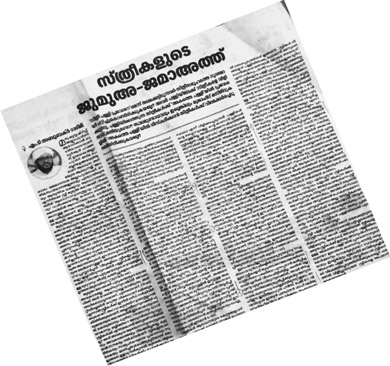
"Whether it is permissible for women to participate in Friday and congregational prayers conducted under an Imam alongside non-mahram men in public places is today a subject of debate between Sunnis the true followers of Ahl-us-Sunnah wal-Jama'ah and advocates of new ideas like the Mujahids. While progressives argue that attending these Jumu'ah and congregational prayers is permissible and meritorious, Sunnis claim that it is forbidden." (Sthreekalum Jumu'ah Jama'athum, Page 9).
See another cleric issuing a ruling of "Haram": "However, if there is a strong presumption or certainty regarding any issue of the presence of non-mahram men either in the mosque or on the way, then it is Haram. There has been no doubt about this for ages. This is a law of the religion, not merely a local custom." (Suprabhaatham, 2025 December 10, Wednesday, Page 6).
Is the "presence of non-mahram men" cited as a reason by them a phenomenon that occurs only when going for prayer? Since there is a possibility of mixing with non-mahram men whenever women step outside, there should be a fear of being tested, and utmost caution must be maintained. Compared to other journeys, their coming to and going from mosques, as well as offering prayers there, is done while ensuring maximum safety.
Yet, during the nercha festivals organized by Samastha announced as having special facilities arranged around mosques and elsewhere as well as annual uruses, Milad-un-Nabi celebrations, various spiritual fraud gatherings, and journeys to fake pilgrimage centers, does the "presence of non-mahram men," which they cite as an obstacle to going to the mosque, not occur in any of these places? Whom are they trying to fool?
Clutching at Straws of Weak Excuses
The final refuge of the clerics, who are reluctant to accept facts, lies in flimsy excuses. Even though what they put forward is hollow, they likely take comfort in having something to cling to. Let us examine some of the weak excuses they present to oppose women's mosque entry a practice sanctioned by the religion:
"This obligation rests upon men. That is why the Prophet ﷺ stated: 'Were it not for the women and children inside the houses, I would have ordered that the homes of men who do not come to the mosque for prayer be set on fire.'" (Suprabhaatham, 2025 December 10, Page 6).
There is nowhere in this Hadith stating that women should not go to mosques or that they should be prevented from doing so, nor is it taught as such a ruling. What this Hadith contains is a stern warning given by the Prophet ﷺ to men who neglected what was obligatory upon them.
However, in another Hadith narrated by Imam Bukhari رحمة الله عليه and Imam Muslim رحمة الله عليه, when the Night prayer was delayed significantly, there is a narration where Umar رضی الله عنه said to the Prophet ﷺ, "O Prophet of Allah, the women and children have fallen asleep." Surely, the clerics could not have missed this. What other option is there for them but to pretend not to see it!
Does this not clearly show that women were present in the mosque for prayer even late into the night? Imam Bukhari رحمة الله عليه brought this Hadith under the chapter heading "Women setting out to mosques at night and for Fajr." Imam Nawawi رحمة الله عليه has also specifically highlighted from this that women were present in the mosque.
Now look at the falsehood fabricated by the cleric citing a Hadith from 'A'ishah رضی الله عنها:
"If the Prophet ﷺ had seen the new condition of women, he would have barred them from the mosque, just as the women of the Children of Israel were barred from the mosque (Muslim 445). Therefore, understand that the rule prohibiting preventing women applies either to the time of the Prophet ﷺ or to elderly women who possess no beauty or attractiveness (Tuhfah 2-252). There are those who have written articles on social media under the heading 'Women's Mosque Entry' claiming that this Hadith of 'A'ishah رضی الله عنها is not proof..." (Suprabhaatham, Page 6).
Since the new state of women marked by visible beauty, adornment, and a lack of modesty that ignites fitnah leads to barring them from mosques, what 'A'ishah رضی الله عنها stated was meant as a call to exercise caution. None of the scholars of Ahl-us-Sunnah have taken this as a statement that completely nullifies the ruling of permissibility. After all, no one has the authority to unconditionally declare forbidden something that textual proofs have permitted.
Since the Hadith begins with "If the Prophet ﷺ had seen," it is also clear that had such a situation existed then, the Prophet ﷺ would have barred them.
While they attempt to restrict mosque entry solely to elderly women, let them also consider the explanation given for this Hadith by Ibn Hajar al-Asqalani رحمة الله عليه:
"If what newly occurred among them (the display of beauty and ornamentation) makes barring them from mosques imperative, then barring them from places like marketplaces is of the utmost priority." (Fath al-Bari).
Look at another 'profound' discovery by the cleric: "The Qur'an does not teach that women should gather in the mosque or participate in the Friday and congregational prayers there. The Qur'an refers to men in several places as the people of the mosque." (Suprabhaatham, Page 6).
Citing Qur'anic verses alone is sufficient as a reply to this. Allah says:
"O you who have believed, when the call is made for the prayer on Friday, hasten to the remembrance of Allah and leave off business. That is better for you, if you only knew." (62:9).
Since this commandment is general, it applies to both men and women. Otherwise, one would have to argue that women are excluded from the rules in numerous similar verses. The term 'Rijal' appears in the Qur'an not only when referring to mosques, but in many other places as well—are women set aside from all of those? Similarly, the word 'Naas' can be seen frequently in the Qur'an; is that also used to exclude women?
See how the cleric attempts to mislead by quoting Imam Shafi'i رحمة الله عليه: "I have no information that any of the righteous predecessors commanded their women to set out for Friday (Jumu'ah) or congregational (Jama'at) prayers, whether by night or day. If there were any virtue in it, they would certainly have encouraged it and granted permission." (Suprabhaatham, Page 6).
The Imams of all four Madhhabs are among those who did not oppose the ruling of "permissibility." The cleric has distorted the discussion held by Imam Shafi'i رحمة الله عليه in his work Ikhtilaf al-Hadith. Furthermore, Imam Shafi'i رحمة الله عليه included most of the Hadiths related to this topic in his famous Hadith collection, Musnad al-Shafi'i, and nowhere in it has a single word opposing this been attributed to him.
Ibn Rajab رحمة الله عليه states in his Fath al-Bari: "We know that there is no difference of opinion among the scholars that a woman should not go to the mosque without her husband's permission. This is the view of Ibn al-Mubarak رحمة الله عليه, Shafi'i رحمة الله عليه, Malik رحمة الله عليه, Ahmad رحمة الله عليه, and others. However, early scholars have opined that the husband's knowledge of his wife setting out without objection is sufficient as permission."
The cleric writes: "The question is raised asking if there are not incidents mentioned during the time of the Prophet ﷺ where women prayed in mosques, observed i'tikaf (seclusion), and prayed in congregation behind men. In reality, all of those are 'practical' occurrences, not directives." (Suprabhaatham, Page 6).
What a joke! They say these are not directives, but merely 'practical' occurrences! Would any female Companion put something into practice in religion without a directive from the Prophet ﷺ? If they put it into practice during the time of the Prophet ﷺ, how could that become an invention of modern innovators?
The clerics have been forced to openly admit that women used to attend mosques for worship during the time of the Prophet ﷺ itself. None of this was a temporary permission; it was meant to be continued. Since the very word 'practical' used by the cleric means 'that which is to be acted upon,' how could it not be in accordance with the Prophet's ﷺ directive?
"The leaders said that Muslims will for all times continue following the exact same laws taught by the Prophet ﷺ fourteen centuries ago, that Islam is not an ideology that undergoes continuous changes and amendments according to the times, and that Muslims are obligated to accept the guideline established by Islam regarding women." (Suprabhaatham, Page 2).
What has been said here is completely true. Is the leadership of Samastha willing to make this statement meaningful in practice? If so, that would resolve the differences of opinion on religious matters. At least now, refrain from crushing the honorable right permitted to women by religion. Make the correct approach of returning to textual proofs your established stance. Be prepared to accept ritual and practical rulings on the basis of evidence, and to return to the exact same laws taught by the Prophet ﷺ fourteen centuries ago.
Translated By: Beena Subair